
Ultra-rare jewel: 1957 Kimball .30 Cal Carbine pistol
Kelly Bostian Aug 26, 2026
Kimball’s 1950s flop now a rare prize for collectors
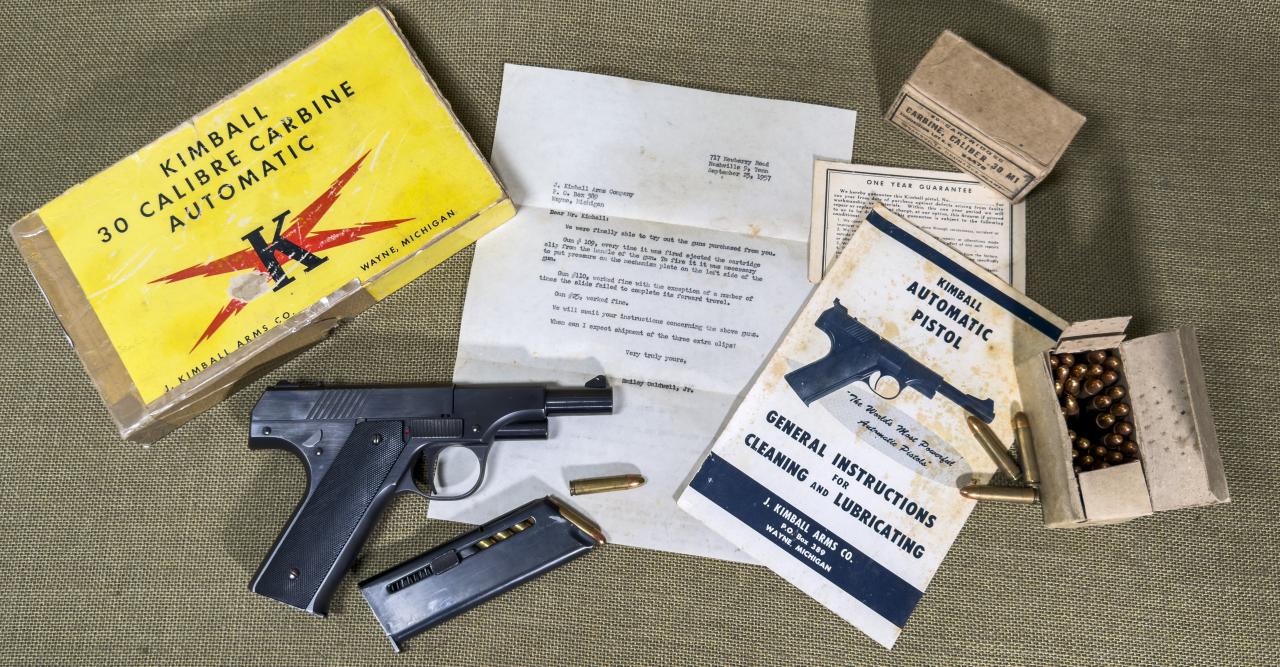
Recoil, engineering doomed .30-Cal Carbine handgun idea
By KELLY BOSTIAN
A cool, ultra rare, lovable loser recently rolled into J Gray’s shop and is now for sale at Guns International.
Firearms history is full of flops, but among the more adorable, rare, and collectible is the J. Kimball Arms Company .30-Caliber Carbine semi-automatic pistol, developed and sold between 1955 and 1958.
Popular literature seems to agree that at least 238 were made; most estimates stop short of 300 total. The gun in our shop, Serial Number #110, was originally purchased in 1957.
Now nearly 70 years old, it is an ultra-rare piece, and it's cool just to hold it in your hand.
With a heft and hand-feel not unlike a 9mm Luger, although a bit heftier, the Kimball looks sharp and feels good in the hand. It is definitely 1950s cool. The steep rake to the backstrap looks extreme at first, but it anchors the hand nicely while accommodating a magazine stuffed with those lengthy .30 Caliber cartridges. With its half-slide, it has the look of an extra-beefy version of Colt's beloved .22 caliber Woodsman.
Unlike either of the aforementioned pistols, however, that grip angle is so steep the pistol will sit upright on a table, nicely balanced on the flat bottom of the grip and magazine. A unique, but likely unintentional feature. It’s a sweetie, until–one can imagine–you pull the trigger.
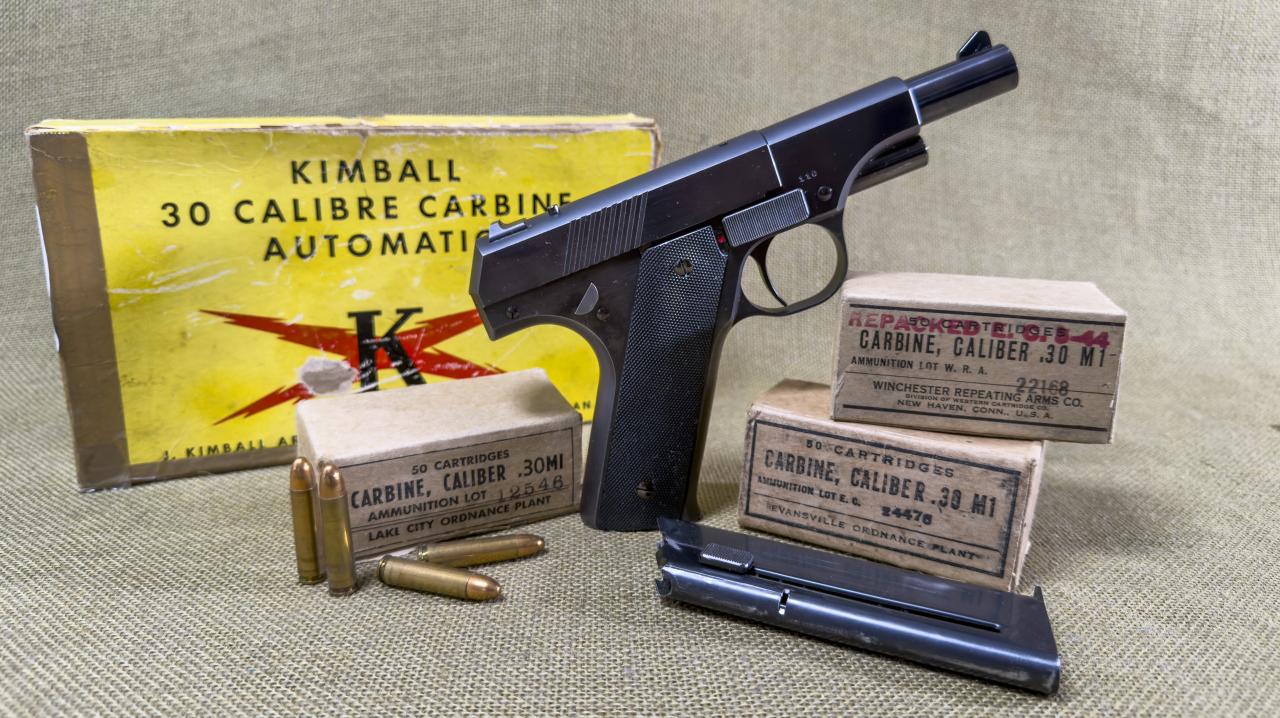
The steep rake of Kimball's grip fits nicely in the hand and accommodates a magazine to hold a rack of the lengthy .30 Cal Carbine cartridges. (KJB Outdoors photo)
With civilian access to M-1 Carbines after WWII, followed by surpluses of carbines and ammo in the late 1950s and 1960s, the M-1 and private-industry knock-offs became incredibly popular.
Think of it as an earlier, although less frenetic, pre-1968 Firearms Act equivalent to today’s AR-platform rifles.
The idea of creating a sidearm so folks could feed their rifle and handgun from the same plentiful, inexpensive ammo surplus made a lot of sense.
That concept definitely worked out well for the 9mm Parabellum.
Then again, the .30 Caliber Carbine was longer and skinnier, holding significantly more powder for a lighter bullet, and delivering muzzle energy (at 18 inches) at least 2.5 times that of the 9mm. And the barrel on this combat model Kimball is just 3.5 inches. The so-called target models have a 5-inch barrel.
It was an engineering challenge to say the least.
And Kimball wasn’t the only company ever to give it a go.
Harry Sanford of Arcadia Machine and Tool added a .30 Carbine to his single-action semiauto Automag III pistols in the 1990s, but those, too, flopped commercially.
With a 1911-style design, shooters complained about the grip size; the best groups came only from those who could get past the head-turning flame-thrower-like muzzle blast, and the guns were known for inconsistent functioning and galling of the stainless steel bolt and slide.
However, both the Kimball and Automag suffered from financial instability of their respective makers.
History holds that Ruger, with its Blackhawk single-action revolver, still holds the title to the best handgun for the .30 Cal. Carbine.
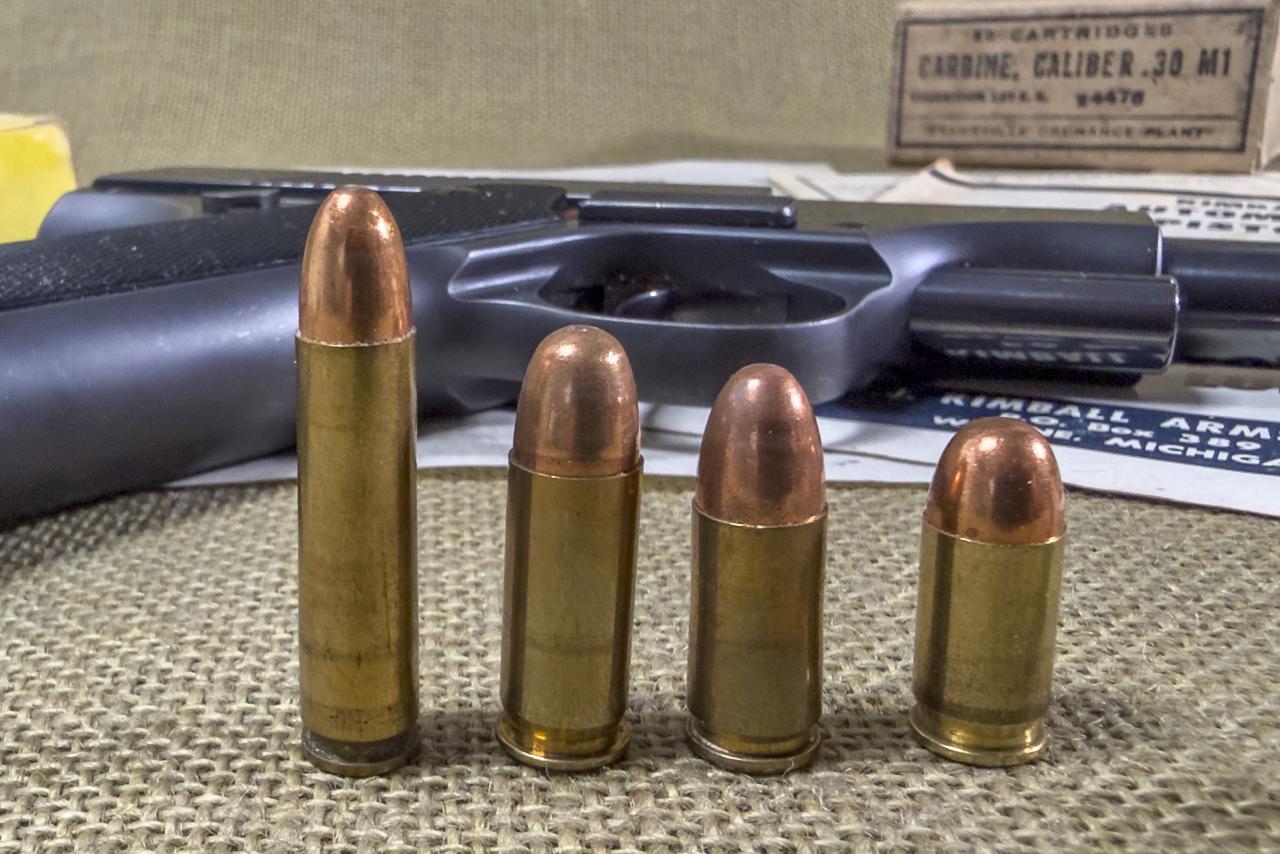
A comparison of cartridges, left to right, the .30 Cal Carbine, .38 Super, 9mm Parabellum, and .380 ACP. (KJB Outdoors photo)
Don’t get the idea that the Kimball was a complete design failure, however. With better financing and a little more engineering help, who knows how far it might have gone?
It had more than its fair share of reported malfunctions, but for a short-barreled semi-auto firing a high-pressure cartridge designed for a rifle with an 18-inch barrel, it did OK. Its stiff double-springed slide and grooved chamber for delayed blowback action were at least headed in the right direction.
An excellent YouTube video for Rock Island Auctions posted by the folks at Forgotten Firearms reviews the mechanics of the Kimballs at this link.
The late great firearms writer Wiley Clapp, writing in American Rifleman in 2014, recalled getting his hands on one and test-firing it, despite its reputation for catastrophic failures. He noted an adequate grouping for a November 1988 Guns & Ammo story.
“I was a bit crazier at that point in life, so I set it up,” he wrote. “I fired the gun (about a dozen shots, as I recall) and got chronograph results. I also got a group on target, which is probably the only recorded evidence of this curious pistol’s accuracy.”
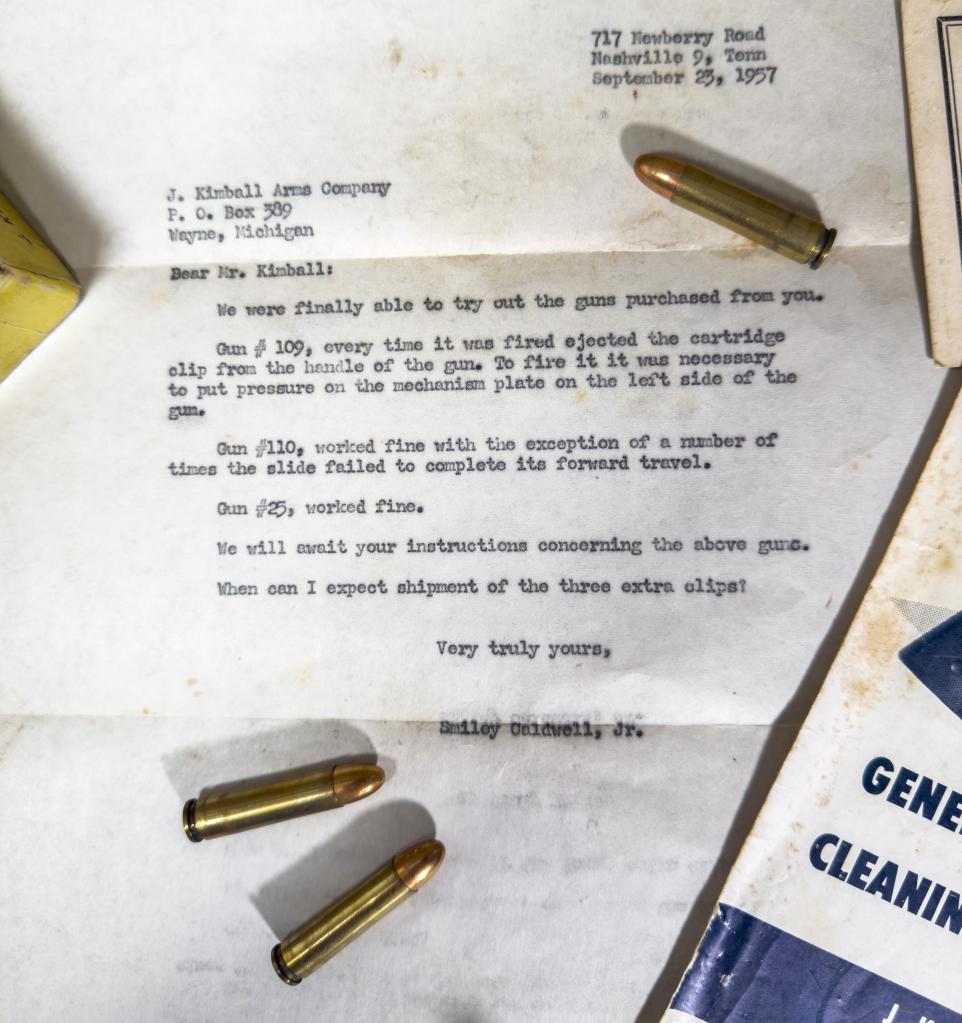
September 1957 letter from Smiley Caldwell Jr. to the J. Kimball Arms Co. (KJB Outdoors photo)
A copy of a letter included with the Kimball # 110 pistol, at J Gray’s, seems to confirm what was apparently repeated in magazine stories of the day and reported by others who tested the gun.
The note is from Smiley Caldwell, Jr., great-grandfather to the consigner of this firearm. The letter, addressed to Wayne, Michigan-based J. Kimball Arms Company, is sent from a Nashville, Tennessee address, and may reflect a father-son effort. The letter states "WE" were finally able to try out the guns..." and an October 1957 Ceramic Society membership list has both Smiley Jr. and Smiley M. Caldwell III at the same address.
The letter lays out the performance of three purchased Kimballs, serial numbers 109, 110, and 25.
It states that pistol #109 ejected the “clip” (magazine) from the grip each time it was fired, that #110 “worked fine with the exception of a number of times the slide failed to complete its forward travel,” and that #25 “worked fine.”
The Caldwells apparently were not completely dissatisfied, however, as the letter ends with a request: “When can I expect shipment of the three extra clips?”
The “clips” did eventually arrive, apparently, as #110 does include an extra magazine, along with the letter, original box, and instruction manual.
It is indeed one cool package.
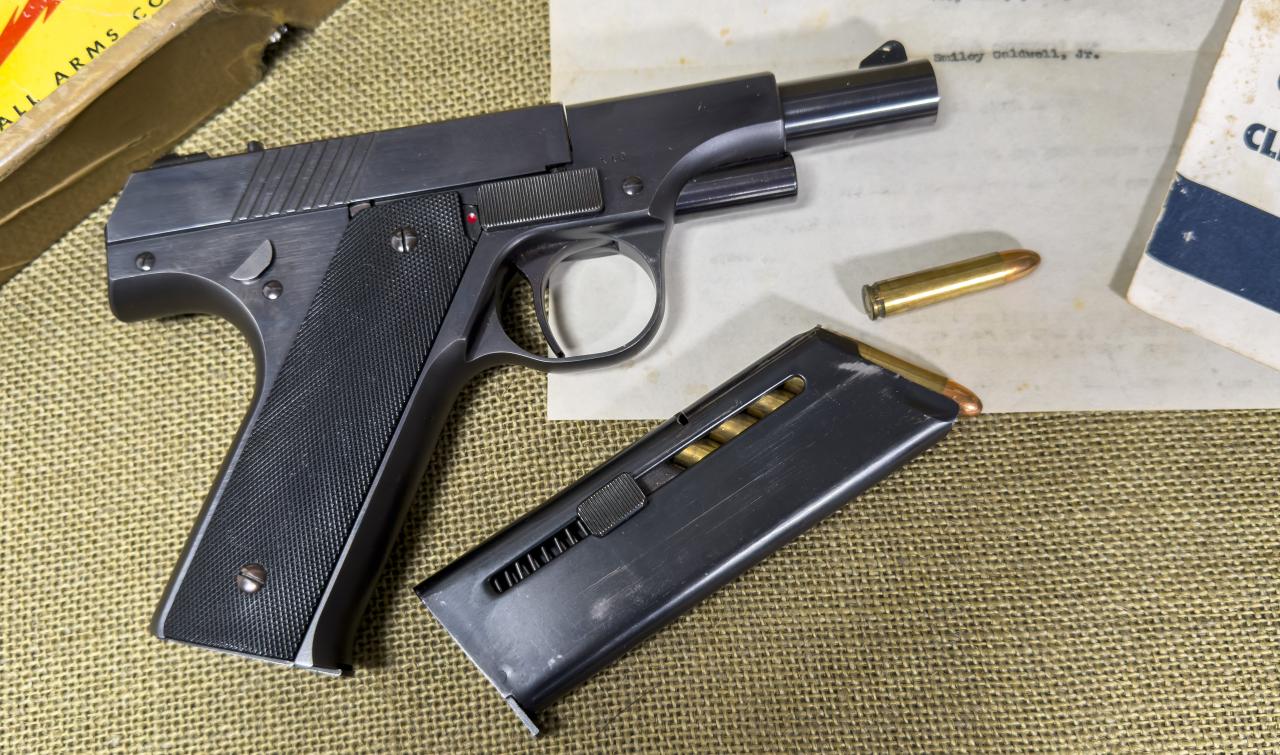
Kimball .30 Cal Pistol, Serial #110, with extra magazine, which holds up to seven rounds. (KJB Outdoors photo)

Store Hours